Case 13 · Fintech · 2015–2016
SEQR Contactless Payments
Phones were still the backup way to pay. I led SEQR’s UX/UI team on one of the first user-friendly contactless mobile payment experiences in Poland.
- Role
- UX Lead at SEQR (Stockholm, Sweden, remote): UX/UI team lead, designer and researcher
- Team
- 3-person UX/UI team · SEQR product team and engineering
- person UX/UI team I led
- 3
- launch KPIs defined
- 4
- Best Customer Centric Excellence Award, Florin Awards Europe
- 2016
01
Phones were the backup
New NFC capabilities let SEQR add contactless payments for Android users. Its platform ran from parking to international transfers, but phones were still seen as secondary, less reliable ways to pay. My job was to win one use case that would earn the trust to justify the rest.
The SEQR payment platform. In-store contactless was one piece of it.
02
Quick stops, not big shops
We mapped the in-store customer journey with the product team, then ran co-creation workshops and interviews. People told us big planned shops went on a credit card and their phone came out for quick stops. So we designed for quick stops and small purchases, where time and reliability mattered most.
The kind of quick stop we designed for.
03
The flow teaches the tap
We had no mobile-payment UX standard to build on, so we added an educational layer. One screen says “Place your phone over the card terminal labeled with the NFC sign”, with a “Thanks, I got it” button. We defined four launch KPIs too: adoption, task success, error rate and time-on-task.
04
Testing at the till
We field-tested in local grocery stores in Łódź with HCE virtualised cards on staging, watching error rate, time-on-task and what happened between cashier and customer. Contactless then went out to Android users. We won the Best Customer Centric Excellence Award at Florin Awards Europe 2016.
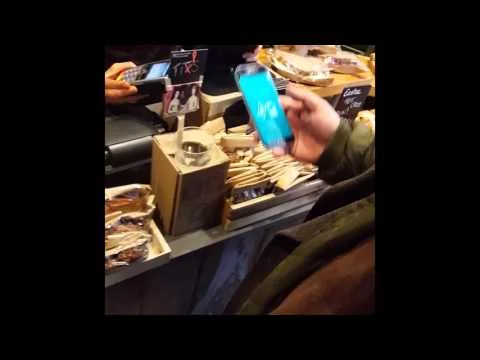
A still from the field-test video.
Looking back
We defined the four KPIs mid-design, which meant round trips where the build was technically correct but didn’t match how we measured success. Next time I’d have research, product and engineering agree in week one on how to count a “successful” contactless payment.